Why Do Dogs Chase Cats, and How Can You Tell If It Is Play or Prey Drive?
Dogs chase cats for a few different reasons, but the difference between playful chasing and prey-driven fixation matters. Reading body language and managing the situation early can keep both pets safer.
On this page
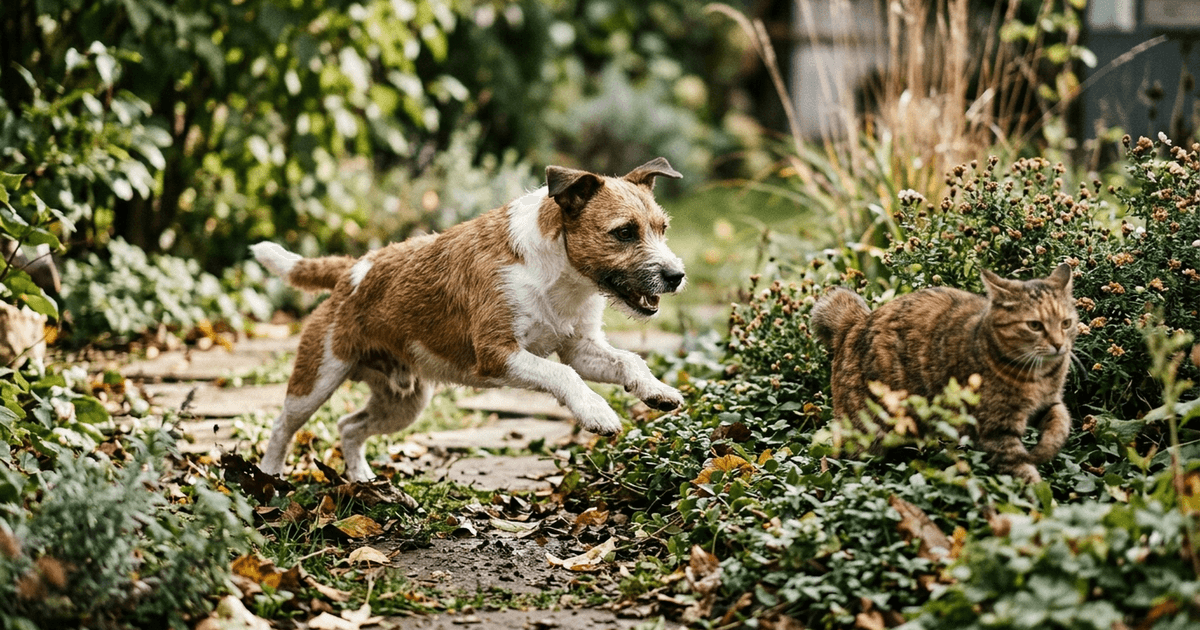
A dog chasing a cat is not automatically being aggressive. Sometimes the behavior is play, sometimes it’s an instinctive chase response, and sometimes it’s a mix of excitement, fear, and opportunity that’s gone too far. The useful question isn’t just why the chase started — it’s whether the dog can still think, listen, and turn away.
Dogs may chase cats because chasing is an instinctive behavior, and that instinct can be strengthened by repetition. It can also show up in play, where running after something moving is part of the game rather than a true attempt to catch or harm it. That’s why the same outward behavior can look very different depending on the dog’s body language and what happens next.
The cat’s side of the picture matters too. A fearful cat may run, which can make the chase more exciting for the dog. And if a cat feels trapped, it may stop fleeing and start defending itself. That’s one reason this can turn from a noisy household problem into a real safety issue so quickly.
Play chase vs. prey drive: what to look for
The easiest way to read the situation is to watch for how the dog is engaging, not just whether it is moving fast. Play tends to look loose and reciprocal. A dog that is still in play mode usually has a bouncy, flexible body, can break off the pursuit, and does not seem locked onto the cat the way a dog in prey-driven chase may be.
Prey drive looks different. The warning signs are fixation, staring, arousal, and an inability to disengage. Petfinder advises redirecting a dog as soon as chasing begins, or even earlier if you see signs like staring or whining that suggest the chase is building. That matters because once the dog is fully aroused, it becomes much harder to interrupt.
A good practical test is this: can the dog hear you, respond, and shift attention away from the cat? If yes, you may be dealing with excitement or playful overinterest. If no — if the dog seems visually glued to the cat, ignores cues, and keeps pushing toward the chase — that leans more toward prey-driven behavior.
Another clue is whether the interaction is mutual. In play, both animals usually have room to disengage, and the rhythm is more balanced. In a true chase, the cat is often just trying to get away, and the dog keeps pursuing no matter what the cat does. That’s not play, even if the dog looks happy or energized.
What to do immediately to keep both pets safe
The first job is prevention. While behavior change is underway, the dog should not get repeated practice chasing the cat. That repetition is part of what makes the habit stick.
A simple safety plan usually works better than hoping the animals will sort it out themselves:
- Separate dog and cat when no one is supervising them.
- Keep the dog on a leash or otherwise under control when the cat is present.
- Watch closely for the first signs of arousal, such as staring, whining, or fixation.
- Interrupt early, before the chase takes off.
- Use calm redirection, then reward the dog for turning away from the cat.
That last part matters. The goal is not just to stop the chase in the moment. It’s to teach the dog that looking away from the cat, calming down, and choosing something else pays off.
For the cat, safety usually means access to places the dog can’t reach. Blue Ridge Humane Society notes that cats need high places, hiding places, and escape routes that are off-limits to dogs. That gives the cat a way to feel safe instead of cornered, and it lowers the odds that a tense encounter will escalate.
If the household is still in the early stages of training, structure helps more than optimism. Supervision, barriers, and short, controlled exposures are far more useful than waiting to see whether the dog “gets used to it.”
Why the chase can keep happening
Chasing can become self-reinforcing. The dog chases, the cat runs, the dog gets a burst of excitement, and the sequence gets rewarded by the movement itself. In community discussions, owners often describe the same pattern: the dog seems to enjoy the chase, and the cat’s retreat appears to strengthen the habit. That experience is common, even if the forum stories themselves aren’t proof on their own.
That’s why exercise alone usually doesn’t solve the problem. A tired dog may be easier to manage, but a dog that has learned cat-chasing as a rewarding pattern still needs supervision, interruption, and replacement behaviors.
When to get professional help
If the dog becomes intensely fixed on the cat, repeatedly ignores redirection, or the cat is living in a state of fear, it’s time to bring in a qualified trainer or veterinarian who works with behavior. The earlier the intervention, the easier it tends to be to prevent the chasing pattern from becoming the household norm.
If you’re trying to make sense of the behavior in a mixed-pet home, the safest frame is usually this: assume the chase matters even when it looks playful. You do not need to prove whether the dog is “mean” before you manage it. You just need to notice whether the dog can disengage, whether the cat has escape routes, and whether the chase is being prevented before it becomes a habit.
That’s the heart of it. Play is loose and reciprocal. Prey drive is sticky, fixated, and hard to interrupt. And in real homes, the smartest response is to manage the space first, then train the behavior second.
Related reading
FAQ
Sources
- Dog chasing/attacking cat plz help!! : r/Dogtraining - Reddit — owner discussion