
What Happens When Cats Eat Catnip, and Why Do Some Cats React So Strongly?
Catnip can look like magic, but the reaction isn’t all the same. Smelling it usually sparks the classic burst of rolling, rubbing, and zooming, while eating it more often leans calm — and some cats barely react at all.
On this page
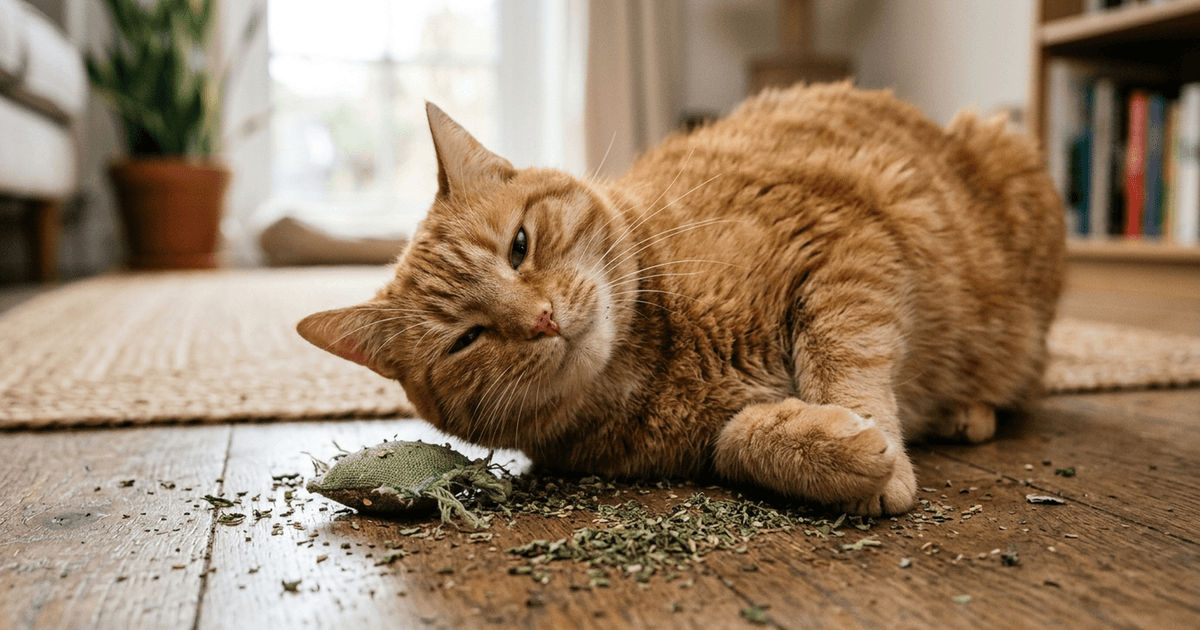
Catnip gets talked about as if it turns every cat into a tiny tornado, but that’s only part of the story. The bigger distinction is between smelling catnip and eating it. Sniffing the plant is what usually brings on the classic excited response; eating it is more often described as calming or relaxing.
That difference matters because it changes the whole picture. A cat rolling, rubbing, purring, meowing, or suddenly racing around isn’t necessarily “wild” in a bad way. Catnip usually causes a short-lived behavioral change, not a medical problem, and many cats show reactions that range from playful to mellow to, in some cases, a little grumpy.
Catnip is Nepeta cataria, a herb in the mint family. Its active oil is called nepetalactone, and that compound is what does most of the work. When a cat smells catnip, the odor is carried through a special scent pathway, which is why the nose matters so much here. In that moment, the plant can trigger a burst of behaviors that may look a lot like excitement, though some cats respond with affection, happiness, hyperactivity, relaxation, or even aggression.
Smelling catnip is usually the dramatic part
If you’ve ever watched a cat investigate catnip and then suddenly start rubbing its face in it, that’s the familiar reaction most people mean. The scent seems to be the main trigger, and the response is often obvious but temporary. One veterinary source describes typical catnip sessions as lasting around 10 minutes, after which cats can become temporarily unresponsive to it for a while.
That short window is useful to know because it helps explain why catnip can seem intense and then vanish just as quickly. A cat may pounce on a toy, roll across the floor, act more affectionate than usual, or get overstimulated. Another cat may simply blink at the herb and walk away.
Eating catnip is a different experience
Cats can eat catnip, and small amounts are generally considered safe. But eating it doesn’t produce the same effect as smelling it. In many descriptions, ingestion is linked more with calmness or relaxation than with the energetic rolling-and-rubbing reaction people expect.
That doesn’t mean cats should be encouraged to overeat it. Too much catnip can cause vomiting or diarrhea, and a veterinary source says serious illness from eating too much is highly unlikely. In other words, catnip is usually more of a nuisance to the stomach than a danger, but a cat that eats a large amount can still end up feeling miserable.
Why some cats react strongly and others don’t
This is the part that frustrates people most, because the reaction is so inconsistent. PetMD notes that about 60% of cats have a behavioral reaction to catnip, which means a substantial minority don’t respond at all. Community discussions often echo the same pattern: one cat acts possessed, while another treats the same plant like background noise.
Age and heredity are often mentioned as possible reasons. Some sources say kittens under about six months are typically less affected, and community conversations frequently point to genetics as a likely explanation for why some cats are enthusiastic and others seem completely unimpressed.
That variation is worth respecting. A cat that ignores catnip is not broken, stubborn, or sad. It may simply be one of the cats that doesn’t carry the sensitivity, or it may just not be in the mood.
How much is too much?
For most cats, catnip is safe in moderation. The main thing to watch for is digestive upset, especially if a cat eats a lot of the plant material. Vomiting and diarrhea are the clearest signs that the amount was too much.
A catnip allergy is considered possible in one veterinary source, but very rare. Serious illness is described as unlikely, which should reassure most owners. Still, repeated vomiting, marked lethargy, or any sign that feels out of proportion to a simple tummy upset deserves a call to a veterinarian.
If your cat ignores catnip, that doesn’t mean much is wrong
A non-response can feel surprising, especially if another cat in the house acts like catnip is the greatest invention ever. But a lack of reaction is common enough that it shouldn’t be treated as a red flag on its own.
For owners who want to try something else, some cat communities mention alternatives such as silvervine or honeysuckle for cats that don’t respond to catnip. Those options come up often because catnip isn’t a universal cat charm; it’s more like one of several possible ways to spark play or interest.
The most useful way to think about catnip is this: smell usually wakes up the show, while eating usually quiets things down. That small distinction explains why the same plant can make one cat roll around like a kitten and let another cat nibble peacefully, and why a third cat may do absolutely nothing at all.