
How Do You Compare Cat Litter Types Without Wasting Money?
The cheapest bag isn’t always the cheapest litter. A smarter comparison looks at how much you use, how often you scoop, and whether a litter actually controls odor, dust, and tracking well enough to save you time and cleanup.
On this page
The easiest way to compare cat litter without wasting money is to stop looking at the bag price first and start looking at the real cost: how long it lasts, how well it controls odor, how much dust it makes, and how much mess it leaves behind. Cat litter is commonly compared across odor control, dust level, tracking, eco-friendliness, and cost, and those factors can change what you actually spend over time.
That shift in perspective matters because a bargain bag can turn into an expensive habit. Cats.com’s affordable-litter coverage argues that litter costs add up quickly, especially in multi-cat homes, and that lower-cost options do not have to mean lower quality. In practice, the cheapest choice is only cheap if it still performs well enough that you’re not replacing it constantly, scooping around clumps that fall apart, or vacuuming litter out of every room.
What really changes the cost of cat litter
The sticker price tells only part of the story. A litter that costs less per pound can still cost more per month if it needs frequent full changes, creates more tracking, or does a poor job with odor control. That’s why review-style comparisons tend to test beyond the bag label and look at longevity and real-world cleanup, not just what the package promises.
A useful way to think about it is this: the best-value litter is the one that gives you the cleanest box with the least wasted product and the least extra work. If you’re scooping less often because clumps hold together well, or if the litter stays fresher for longer, you may spend more on each bag but less over the month.
Purina’s litter guide breaks the choice into practical categories like odor control, dust level, tracking, eco-friendliness, cost, and best use case. That’s a better framework than asking only which litter is cheapest, because the answer depends on what you’re trying to solve in your home.
How the main litter types tend to compare
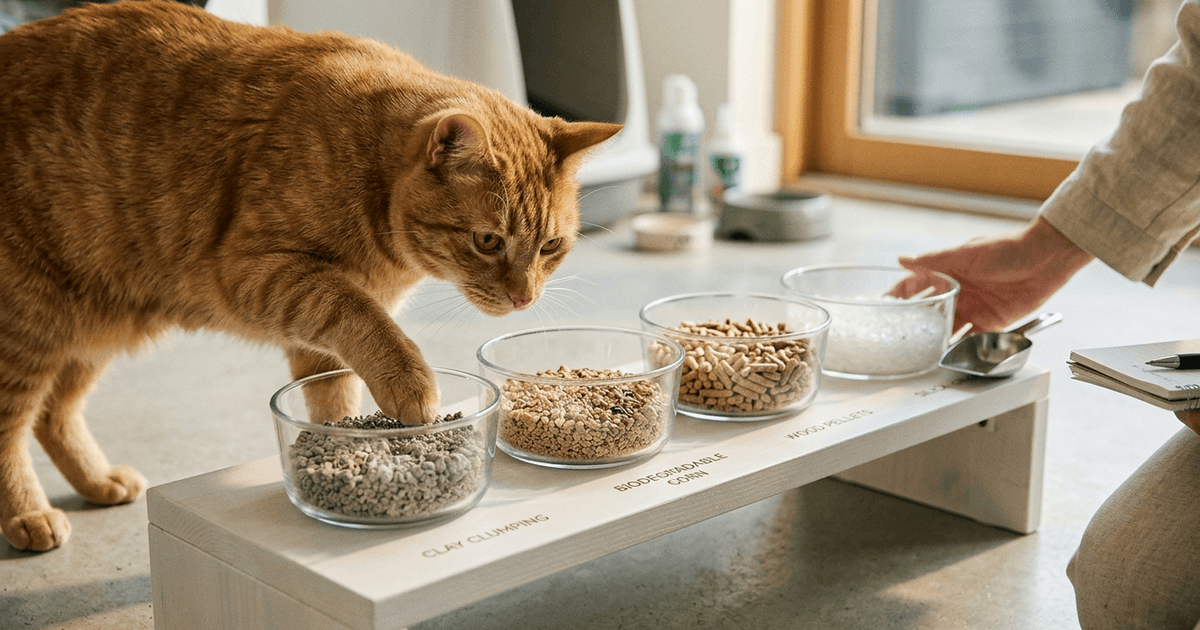
Clay is widely presented as the most common litter type and often the lowest-priced. Purina’s guide also describes clumping clay as a strong fit for easy scooping and odor control, while non-clumping clay is presented as a budget-friendly option for single-cat homes. In other words, clay often wins on upfront price, but the real question is whether it keeps your routine simple enough to stay economical.
Silica gel, sometimes called crystal litter, sits at the other end of the price spectrum in many comparisons. Purina describes it as very low dust and suited to owners who want long-lasting, low-maintenance litter. That can matter if you’d rather buy less often and do less daily maintenance, even though the bag usually costs more.
Paper litter is described by Purina as being made from recycled materials and as very low dust. Wood litter is described as typically natural, low dust, and suited to eco-conscious owners or cats sensitive to dust. Those options can make sense when dust or material preference matters more than the lowest shelf price.
Cats.com’s type guide also shows how wide the spread can be across materials. In the snippet provided, clay appears at $1.06 per pound and silica gel at $3.35 per pound, which illustrates the price gap you’re often weighing. The same guide lists multiple other materials, which is another reminder that “natural” doesn’t automatically mean “cheap,” and “cheap” doesn’t always mean “best fit.”
Litter type | What it tends to do well | Cost signal from the research |
|---|---|---|
Clay | Common, often budget-friendly, strong everyday utility | Often lowest-priced; Cats.com snippet shows clay at $1.06/lb |
Silica gel | Very low dust, long-lasting, low maintenance | Higher-priced; Cats.com snippet shows $3.35/lb |
Paper | Very low dust, recycled material | Often chosen for low-dust needs |
Wood | Natural, low dust, eco-conscious fit | Usually pricier than basic clay |
Cheap upfront vs. cheap over time
The trap is assuming that a lower bag price always means lower total cost. A litter can be inexpensive and still waste money if it breaks down too fast, smells up the house, or tracks everywhere. That’s especially true in homes with more than one cat, where the box turns over faster and every small inefficiency gets multiplied.
A bag that lasts longer can be the better buy even when the price tag is higher. Review sites that test many litters make this point implicitly by judging performance alongside price. Cats.com says its 2026 best-cat-litter guide was based on testing 50+ litters, which matters because value is harder to judge from a shelf label than from actual use.
Think about a simple comparison:
- Litter A is cheap, but it smells sooner and needs more frequent full changes.
- Litter B costs more, but it controls odor better and stays usable longer.
Litter B can end up being the less expensive choice if you use less of it over time and spend less effort cleaning around it.
That’s the real lesson of total cost of ownership. You’re not buying a bag of granules; you’re buying a daily system for odor control, cleanup, and household peace.
What to weigh first in your own home
Your best litter type depends on the problem you’re trying to solve.
- Choose clumping clay if you want a familiar, usually lower-priced option that supports easy scooping and strong odor control.
- Choose silica gel if low maintenance and low dust matter more than upfront price.
- Choose paper if you’re prioritizing very low dust and recycled material.
- Choose wood if you want a natural, lower-dust option and you’re comfortable paying more for that tradeoff.
Purina’s guide also frames wood litter as a fit for eco-conscious owners and cats sensitive to dust. That’s useful because sometimes the best value is not the cheapest product, but the one that avoids a problem you’d otherwise have to solve in another way.
What owners usually notice first
Real-world discussions from cat owners tend to focus less on brand names and more on daily annoyances: mess, household smell, tracking, and how long a bag lasts. Those are the things that determine whether a litter feels affordable after a month of living with it.
User reports can be especially revealing about texture and cleanup. One Reddit user said pine litter turned to dust once urinated on and became messy. Another said wheat litter hid odor well but made the whole house smell like wheat. A third said wood pellets were cheaper and lasted a couple of months for one cat. Those are individual experiences, not proof, but they point to the kinds of tradeoffs people actually notice.
That matters because the “best” litter on paper can still be the wrong fit in a real home. A product that sounds economical may be irritating to clean up, or it may solve odor but create a smell of its own.
A simple way to compare litter without overpaying
Use this order instead of shopping by unit price alone:
- Look at the cat’s needs first: dust sensitivity, odor control, and whether you need clumping.
- Compare how long the litter seems to last in real use, not just the pound price.
- Factor in cleanup: tracking, dust, and how often you’re vacuuming or sweeping.
- Think about your household size, especially if you have multiple cats.
- Decide whether a more expensive litter could still be cheaper once you count the extra maintenance it saves.
That approach keeps you from falling for the cheapest-bag mistake. The goal isn’t to buy the least expensive litter on the shelf. It’s to buy the litter that costs the least once you include odor, mess, and how often you’ll actually have to replace it.
If you want more pet-care buying guides like this, browse our latest articles.
FAQ
Sources
- Reddit — What kind of cat litter do you like the most? Pros and cons? — owner discussion